
Finding the Story in Mycenae
As the new year approaches, some ruminations on the present and the past

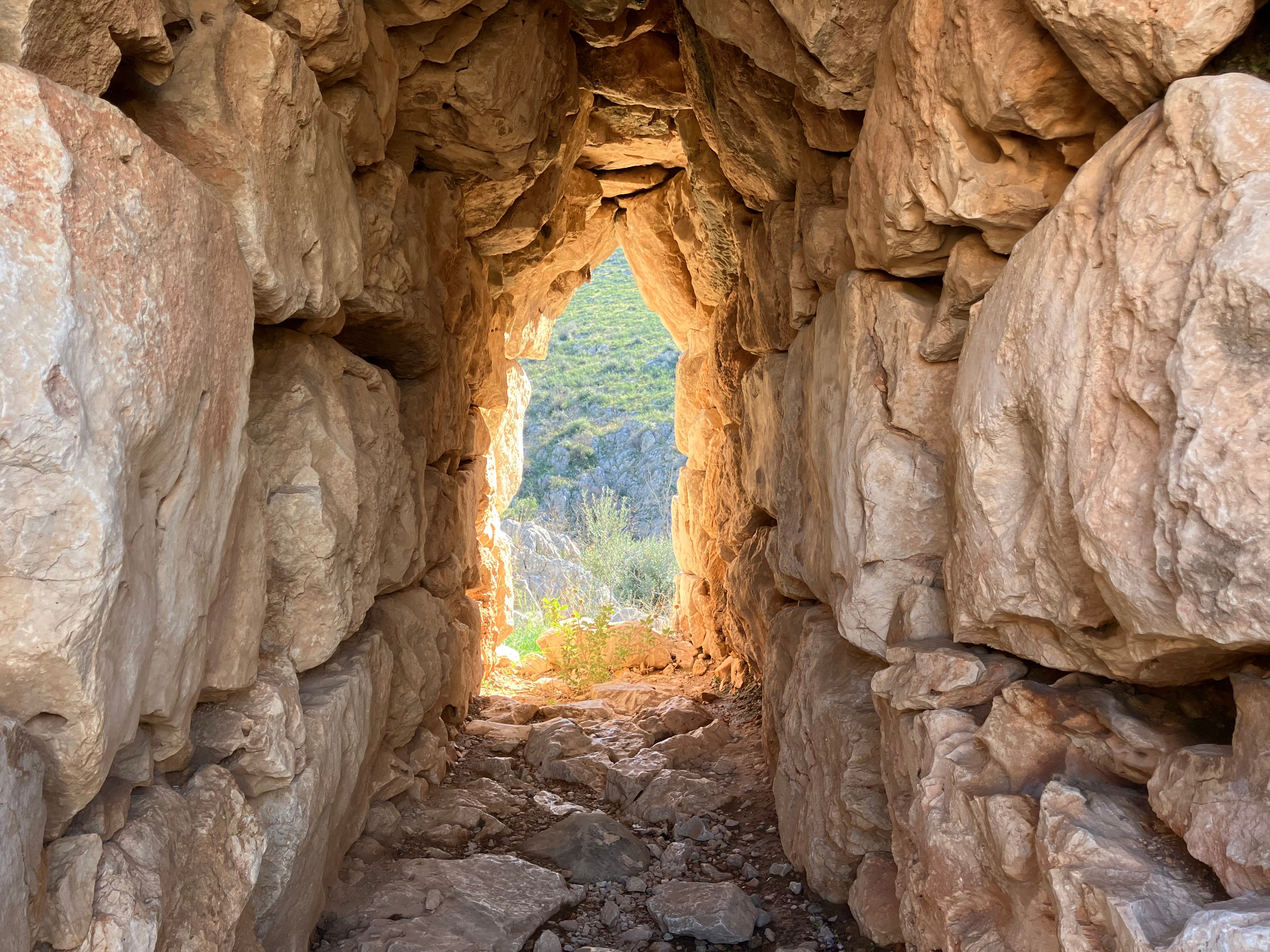
In Mycenae it was the tombs that struck me the most. Huge underground structures built of layers of closely-fitted stones, layers rising up around you as you stand in the echoing center of what is essentially a gigantic stone egg. One for Clytemnestra, and one for Aegisthus. I thought of all the work it took to build them, of weeks or months spent digging in the ground, hauling earth away, lifting and carrying stones. Had they put as much energy into the palace itself? Doubtless they had, but the below-ground nature of the tombs has preserved them, so that today they are largely intact while the palace shows but traces of its former glory. The tombs are symmetrical, orderly, and well-crafted. And meant to be used, of course, not by the living but by the dead.
Yet the dead are present in the palace as well, for as soon as you enter through the famous Lion gate you are greeted with more tombs, large circular rooms standing to the right of what was once a corridor. After that comes the granary—a source of nourishment and life, surely—yet nevertheless it is the tombs that you meet first after walking beneath those silently roaring lions of stone. Why did those who lived here give those tombs so prominent a place? What does that say about their relation to the dead, and to the past?
Mycenae was a palace at the center of a kingdom which ruled all of Greece for approximately seven hundred years. It was a place of power, and so in thinking about their relationship to the dead we might imagine such tombs in a modern-day place of power such as the White House. How would it be if visitors to that building first saw, upon entering, the graves of Washington and of Lincoln? Monuments to past presidents are a prominent part of the Washington skyline, to be sure, yet those monuments are far from the rooms where political decisions are made; and though those rooms are decorated, so I hear, with paintings of presidents of the past still those paintings show them “as they were in life,” emphasizing their heroic nature and not the fact that they are dead and gone. The Mycenean relationship with the dead was different, and feels closer to the customs of the ancient Egyptians than to anything from our day.
This relationship to death and the underworld is found in the Odyssey as well, when Odysseus journeys to Hades to speak with Tiresias, the blind seer of Thebes. Tiresias has crucial information for Odysseus about how to get home, yet there is a larger understanding behind these practicalities, an awareness that at a certain point in your life you will find that you are unable to move forward—to change or to grow—unless you first reconcile yourself to the ghosts of the past. For to honor the past is to free yourself from it, and those unwilling to make the required journey into darkness and back out again may find themselves ruled by voices unheard. It’s a truth, I think, that Americans in particular like to forget.
The museum at Mycenae was filled with quietly marvelous things. Some of the earliest inscriptions in the Greek language are there, as well as beads, bowls, and coins from far-flung places such as modern-day England, Africa, and the Caucasus, a testament to how connected this kingdom was with the most distant reaches of their known world. Yet to those who read the words on the museum signs closely a surprising truth becomes clear: nearly half of the objects in the museum were excavated from tombs nearby, where they were left as offerings to gods, goddesses, or heroes of the past. You’d think that by walking away from those tombs and into the museum I had left the underworld behind, but in fact to look at those objects was to enter those tombs again, though in a radically different way.
For it’s disturbing to realize that we have taken offerings which were intended to remain buried in the earth and placed them in full view in brightly-lit cases of glass. We have moved them from darkness to light, from the realm of the underworld to the solar, mental realm of the museum. Not only this, but we have effectively taken a gift away from the gods. In the human realm, it’s like giving someone a birthday present and then returning a week later to reclaim it for ourselves. Not a polite thing to do, surely; and when the recipient is a divine being probably not a very safe thing to do either. But we are inheritors of the Enlightenment, and as such believe that all things should be described, examined, and explained.
Despite chronology we often think of the ancient Greeks as part of this tradition, as though they were rational materialists just like many of us today. Scholars of the Odyssey, for example, seem to enjoy pointing out what they see as the deliberate way in which Homer separates Odysseus’ magical adventures—narrated by him, and so potentially imaginary—from his journeys through the “real world.” There are no giants or sea monsters in Ithaca, certainly. Yet so-called “magic” is never far from that world, whether it is a thunderbolt hurled by Zeus out of a cloudless sky or the bodily transformations Odysseus endures through the actions of Athena, the goddess of wisdom and strategy. The later Hellenistic Greeks do in part deserve their reputation as clear-thinking rationalists, but only in part. For the fact remains that for much of its long history the ancient Greek culture maintained strong relationships with dreams, the gods, and the dead.
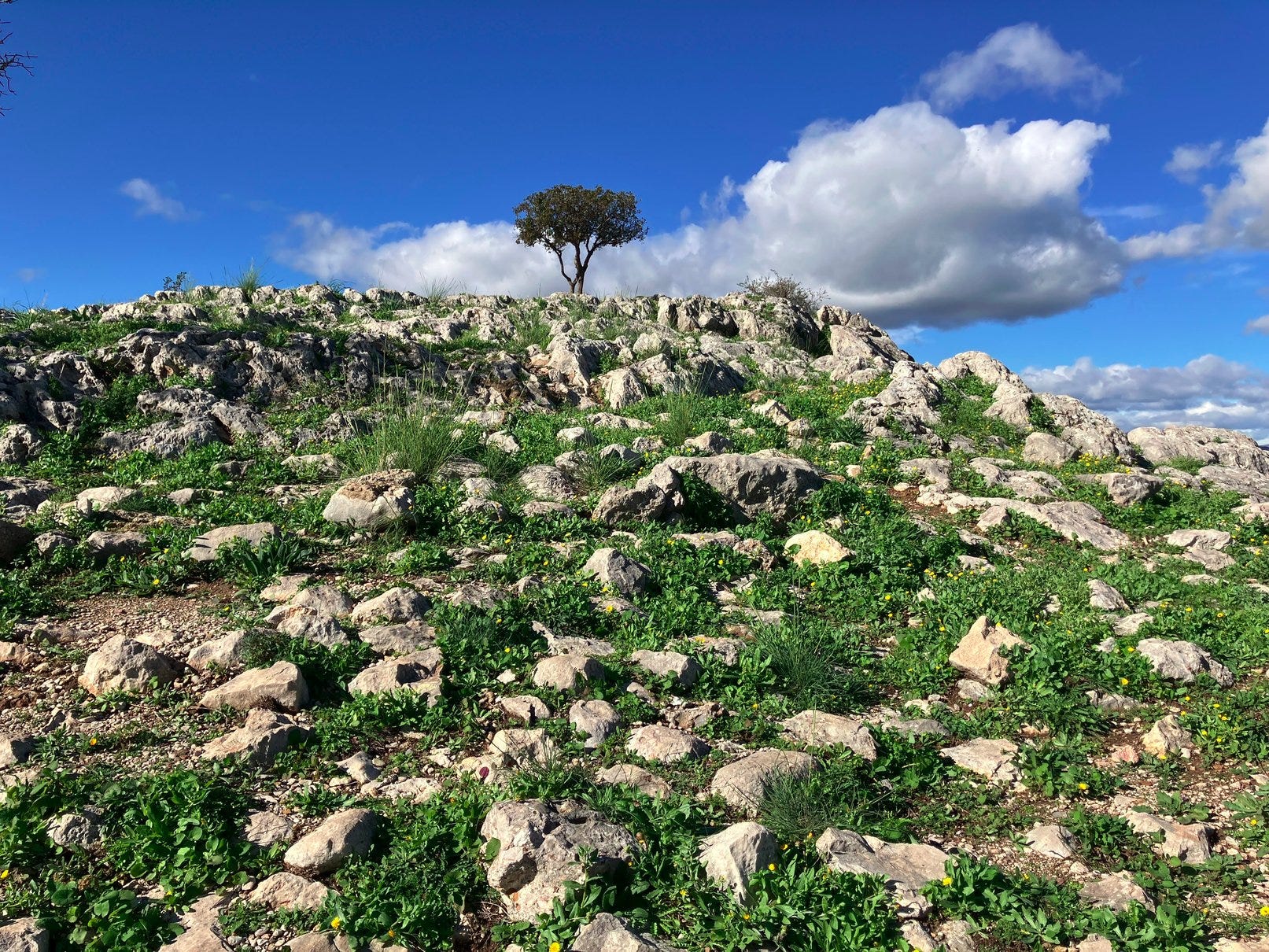
Photo: view of the peak of the hill of Mycenae
Our culture considers these relationships to some degree during the holiday of Halloween, and perhaps for that reason these Mycenean ruminations feel a bit out of place amid the holiday season. Yet the winter holidays are also a time in which we all prepare ourselves to collectively step into a new year. And if we are to do so not with regret but with joy, what better action can we take than to reconcile ourselves with the past?
One glass case at the museum was filled with votive offerings to Agamemnon, the legendary king of Mycenae who is said to have led the Greeks in the Trojan war. A small sign told me that, like Clytemnestra and Aegisthus, he too had a resting place, a small structure now in ruins some distance from the palace. From the map on the wall I could see that it was about a twenty-minute walk away, so I decided to go there.
What I found was a dirt road leading away from the highway, away from a few hubcaps and crushed cans towards a stream. There was no sign. The road followed the stream for awhile and I did too, looking for clues. There were olive trees, some bushes, and more garbage; a telephone pole, a piece of rusty metal. And then amid the grasses I saw large white stones piled atop one other, stones far too large to have been moved by a single person. A Mycenean bridge, the map had said. And beside that bridge was another heap of stones almost buried in earth, stones looking like a fallen-in wall. I clambered down the bank and to the stream and stood beside them.
A few white stones amid fallen olive leaves, with the bare trace of a stream trickling faintly past. Was this it? Myth—or history—tells us that Agamemnon was killed by his wife and her lover Aegisthus upon his return from the Trojan war, and no doubt they threw his body to the dogs or worse. Agamemnon was then avenged by his son Orestes, who killed in turn both Aegisthus and his own mother Clytemnestra. It’s a horrible, tragic, and gripping story, a story that was portrayed on vases, described by Homer, and acted out in plays by both Aeschylus and Sophocles.
Agamemnon is not a very sympathetic character, to say the least, and the list of his crimes is long. Yet I was moved to learn that travelers made offerings to him at that particular spot by the river for over two thousand years; moved to think of his son Orestes erecting a memorial to his father there, as a way of giving his troubled spirit peace at last. As though above and beyond all our opinions about good and evil, making peace with the dead is what is most important. A peace, in this case, not expressed through an immense beehive-shaped tomb but through a smaller structure now reduced to a heap of white stones beside a stream. As I stood there the grasses beside that stream stirred briefly in the wind, and then went still.
Great writing, Jay!